For other books on Washington,
DC click
here.
| The following is a
two-part story on the old Baltimore Orioles and what happened
to them. |
June
21, 2009
Baseball Pedigree
|
1. President Theodore Roosevelt invited
his home town jamor league baseball team, the New York Highlanders,
to the White House. Two of the Highlanders went on to gain prominence
with the Washington Senators and are now in the Baseball Hall
of Fame:
Clark Griffith became manager of the Senators
in 1912, then purchased the team.
Jack Chesbro, one of the game's best hurlers,
was the Senators' pitching coach in 924.
|
2. The Highlanders were originally
the Baltimore Orioles, one of the top National League
teams until they dropped them, and four others, in 1899.
The National League retained eight teams
that would remain in place until 1953: Philadelphia, Boston,
Pittsburgh, St. Louis, Brooklyn, Cincinnati, New York, and Chicago.
|
3. Byron Bancroft Johnson, head of
the Western League, changed its name to the American League
in 1900. Then, he took over the Orioles' franchise and began
to lure top players such as John McGraw and Cy Young away from
the National League.
In 1901 he announced, "The American League is now a major
league with teams in these cities!"
Shown on the map are: Milwaukee*, Detroit, Chicago, St. Louis,
Boston, Cleveland, Philadelphia, Baltimore, and Washington.
*Johnson moved the Milwaukee franchise
to St. Louis in 1902. The St. Louis Browns became the
current Baltimore Orioles in 1954.
|
4. Eager for a team in New York,
Johnson was willing to sell the Orioles to anybody who could
come up with the cash.
The buyers turned out to be a professional
gambler and a former corrupt Chief of Police of the City of New
York.
continued...
|

June 29, 2009
Last of two parts about the story of the original Baltimore Orioles
and the New York Highlanders
This week: The Burglars' Ball Club
Panels on the
top row:
1. In 1903 Ban Johnson, President
of the American League, sold the Baltimore Oriolses franchise
for $18,000 to a pair of shady characters in New York.
(Characters in the drawing from left: Johnson, "Big Bill"
Devery, and Frankie Farrell)
2. "Big Bill" Devery made a small fortune on graft
and payoffs as Chief of the New York City Police Department.
3. Frankie Farrell was part owner of about 250 poll rooms and
a swanky gambling joint at 33rd and 5th Avenue,
4. now the site of the Empire State Building.
5.Devery and Farrell leased ground from the New York Institute
and built a ball park at 168th and Broadway. It was the highest
point in the city, which inspired the name of |
Panels on the bottom
row:
6. the team...the New York Highlanders.
7. Aware of the owners' reputations, the fans nicknamed the team
the "Burglars."
8. Having difficulty fitting "Highlanders"
into the traditional single column headline, sports editors began
to refer to the team as
9. the Yankees!
10. On January 29, 1915 Farrell
and Devery sold the Yankees to brewery owner Colonel Jacob Ruppert
and Col. Tillinghast L'Hommedieu Huston for $460.000.
Note in the background is the name of the
beer which Ruppert produced, Knickerbocker Beer.
|

 |
The Games
Presidents Play--Sports and the Presidency by John Sayle Watterson
The Games Presidents Play provides a new way to view the American presidency.
Looking at the athletic strengths, feats, and shortcomings of
our presidents, John Sayle Watterson explores not only their
health, physical attributes, personalities, and sports IQs, but
also the increasing trend of Americans in the past century to
equate sporting achievements with courage, manliness, and political
competence.
"Sports historian Watterson
suggests that presidents' athletic endeavors reveal a lot about
their actions in office... An enjoyable study of politics and
culture." -- Publishers Weekly
"Watterson's history rises above trivia... Abundantly anecdotal...
A wry and perceptive work." -- Booklist
7" x 9½" 402 pages, index, photos, hardbound
#497 Games Presidents Play $29.95
 |
 |
Deadball Stars
of the American League
Edited by David Jones with a foreword
by Keith Olbermann
The dead-ball era is a baseball term used to describe the period
between 1900 (though some date it to the beginning of baseball)
and the emergence of Babe Ruth as a power hitter in 1919. In
1919, Ruth hit a then-league record 29 home runs, a spectacular
feat at that time. The dead-ball era refers to a period in baseball
characterized by low-scoring games and a lack of home runs. The
lowest league run average in history was in 1908, when only 3.4
runs were scored per game. This book chronicles the eight original
teams in the American league with detailed biographies of many
of its major players.
8½" x 10½" 416 pages, 200 photos,
index, paperbound
#498 Deadball Stars $24.95  |
Here are two volumes containing reproductions of Flashbacks cartoons:
 |
A Cartoon of the
District of Columbia Flashbacks
Volume One Patrick M.
Reynolds brings history
to life with a sense of humor. His exciting drawings put you
on the scene with the conflicts, madness, plus the wheeling and
dealing that resulted in the location and construction of the
U.S. capital city. This book covers the early history of DC from
1776 to 1863. You'll be surprised at how many cities served as
the U.S. capital; you'll be amazed that the city was built--despite
all the bickering, petty jealousies, and down-right stupidity.
11¾" x 7½" 106 pages, full color illustrations,
index, paperbound ISBN 0-932514-31-6
#F1 Cartoon History of DC $14.95  |
 |
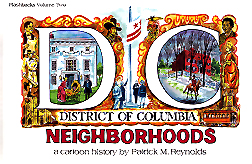
DC Neighborhoods Flashbacks
Vol. Two Artist-writer Patrick M. Reynolds takes
you to the Washington that tourists seldom see The U.S. capital
expanded with the growth of public transportation into such areas
as Shepard Park, Takoma Park, Chevy Chase, Kalorama, Dupont Circle,
Adams Morgan, Capital Hill, LeDroit Park, Tenleytown, Brookland,
and others. Stories in this book go back to the explorations
of Capt. John Smith in the 1600s and the Indian Wars of early
Virginia, continuing into the 20th century with the introduction
of the cherry trees to Washington and the end of segregation
in public schools.
11¾" x 7½" 106 pages, full color illustrations,
index, paperbound ISBN 0-932514-33-2
#F2 Cartoon History of DC $14.95  |
|